Frog Spiritual Meaning: Transformation, Luck & Cleansing Symbolism

In the realm of spiritual symbolism, the frog holds a powerful and multifaceted place. This amphibious creature bridges the physical and ethereal realms, offering insight and guidance on your personal journey. From fertility and abundance to emotional awareness and transformation, the frog’s symbolism runs deep, compelling you to explore its significance. As you uncover the rich tapestry of frog symbolism, you’ll discover how this captivating creature can shed light on your own spiritual growth and the mysteries that lie beyond the veil of the physical world.
Key Takeaways
- Frog symbolizes transformation, renewal, and the ability to adapt to changing circumstances, reflecting the cyclical nature of existence.
- Amphibious nature of the frog represents the capacity to navigate between physical and spiritual realms, promoting intuition and awareness.
- Frog’s association with water, a symbol of purification and fertility, is linked to cleansing, renewal, and manifesting abundance.
- In Hindu culture, the frog is revered as a symbol of the goddess Lakshmi, representing wealth, prosperity, and financial stability.
Introduction to Frog
Frogs are amphibians found in various habitats across the globe, from wetlands to forests. These fascinating creatures have been the subject of fascination and symbolic meaning for cultures around the world.
With their unique anatomy, life cycle, and behaviors, frogs offer a wealth of insights into the natural world. As cold-blooded animals, frogs rely on their environment to regulate their body temperature. They’ve moist, permeable skin that allows them to absorb water and oxygen, enabling them to live both in water and on land.
Frogs undergo a remarkable transformation during their life cycle, starting as tadpoles that metamorphose into adult frogs with legs, lungs, and a new set of adaptations. Frogs’ diverse calls, from gentle croaks to loud ribbits, are a familiar sound in many ecosystems. These vocalizations serve various purposes, such as attracting mates, marking territory, and communicating with other frogs.
Their unique appearance, with large eyes, powerful hind legs, and vibrant colors, has made frogs a captivating subject for artists, storytellers, and nature enthusiasts alike.
What Does It Mean When You See a Frog ?
Seeing a frog can hold profound spiritual meanings, offering insights into your life’s journey and the interconnectedness of all living beings. When you encounter a frog, it may represent transformation, renewal, and the ability to adapt to changing circumstances.
Frogs are often associated with the element of water, symbolizing emotional depth, intuition, and the flow of energy. Their amphibious nature, moving between land and water, can signify your own transition between the physical and spiritual realms.
The frog’s connection to the element of water may also suggest a need to cleanse, purify, or reconnect with your emotions. Its ability to move gracefully between different environments can encourage you to be adaptable and open to new perspectives.
Additionally, the frog’s association with fertility and abundance may indicate a time of growth, renewal, and manifesting your deepest desires. Pay attention to the messages the frog brings, as it can offer valuable guidance and inspiration on your spiritual path.
Frog Symbolism
Building on the profound spiritual meanings associated with seeing a frog, its symbolism offers a rich tapestry of insight into your life’s journey. The frog is revered across many cultures as a symbol of transformation, rebirth, and the cyclical nature of existence.
Its ability to effortlessly transition between the realms of water and land represents your own capacity to navigate the duality of the physical and spiritual worlds. Furthermore, the frog’s connection to water signifies the emotions, intuition, and subconscious aspects of your being.
Its message encourages you to dive deep within, to cleanse and purify your inner landscape, and to embrace the fluidity of change. The frog also symbolizes the connection between the earthly and the divine, reminding you to maintain a balance between the material and the spiritual.
As you contemplate the frog’s symbolism, consider how its teachings can be applied to your personal growth and transformation. Allow its presence to inspire you to cultivate a greater sense of adaptability, emotional intelligence, and spiritual awareness.
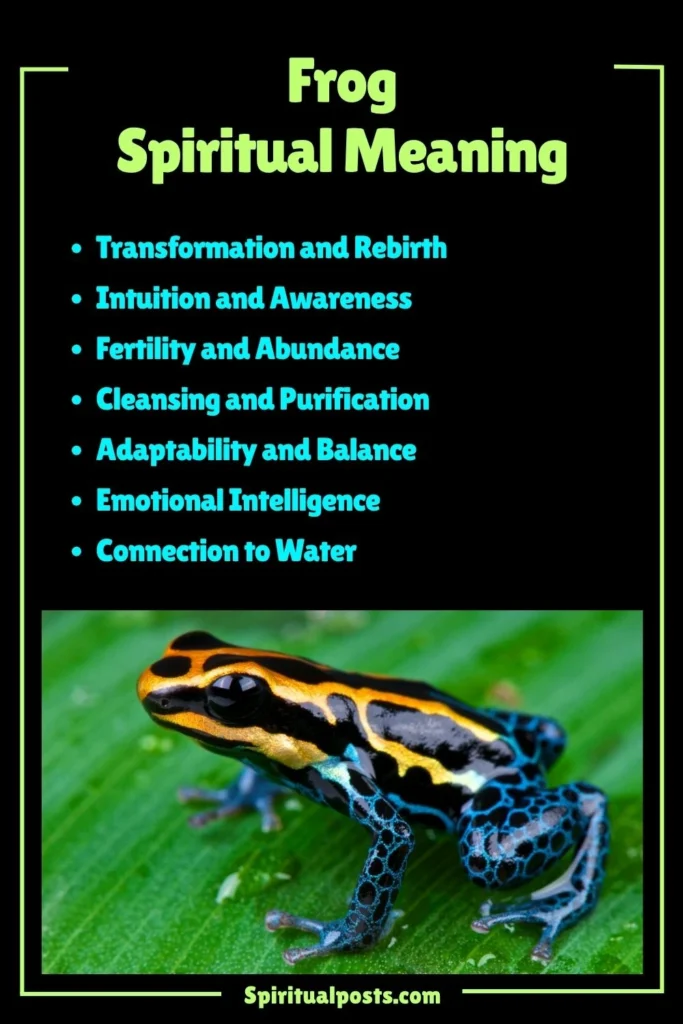
7 Spiritual Meanings of Frog
The frog holds deep spiritual meanings, representing transformation and rebirth.
It signifies intuition, awareness, and the ability to adapt and maintain balance.
Additionally, the frog is associated with fertility, abundance, cleansing, and purification, making it a powerful symbol in many spiritual traditions.
Transformation and Rebirth
Why do frogs often symbolize transformation and rebirth in spiritual traditions? These amphibious creatures embody a profound cycle of change, emerging from the water as fully-formed adults after metamorphosing from their larval tadpole stage. This remarkable process mirrors the idea of spiritual transformation, where one sheds old patterns and limitations to embrace a renewed, higher state of being.
Frogs’ ability to transition between aquatic and terrestrial environments symbolizes the journey from the material to the spiritual realms.
Their shedding of skin represents letting go of the past and embracing a new phase of life.
The frog’s association with water, a universal symbol of purification and renewal, reinforces its connection to transformation.
The frog’s vulnerability during its metamorphosis mirrors the personal growth and vulnerability experienced during spiritual transformation.
The frog’s resilience and ability to thrive in diverse environments inspire hope and the belief that one can overcome challenges and emerge stronger.
Intuition and Awareness
In addition to representing transformation and rebirth, frogs are often associated with heightened intuition and awareness in spiritual traditions.
The frog’s ability to live in both the water and on land is seen as a symbol of its capacity to navigate between the physical and spiritual realms. Its keen senses and adaptability are believed to endow it with a heightened intuitive perception, allowing it to sense energies and forces that may be invisible to the human eye.
The frog’s connection to the element of water is also significant, as water is often linked to the subconscious mind, emotions, and the flow of intuitive insights. By meditating on the frog or incorporating its imagery into spiritual practices, individuals may find that their intuitive abilities are strengthened, and they become more attuned to the subtle energies and messages present in their environment.
The frog’s amphibious nature serves as a reminder to balance rational thinking with intuitive awareness, creating a holistic approach to understanding the world around us.
Fertility and Abundance
Frog’s deep connection to the element of water symbolizes its role as a powerful harbinger of fertility and abundance in many spiritual traditions.
Frog’s amphibious nature, able to thrive in both water and on land, represents the integration of the material and spiritual realms. This dual existence signifies the frog’s ability to bridge the gap between the seen and unseen worlds.
In many cultures, the frog’s prolific breeding and the miraculous transformation from tadpole to adult are seen as emblems of regeneration, renewal, and the abundant flow of life. Its association with rain and the replenishment of water sources further solidifies its links to fertility and prosperity.
The frog’s rhythmic croaking is often interpreted as a call to awaken our own creative energies and embrace the cyclical nature of life. Its presence is thought to attract wealth, abundance, and good fortune, making it a powerful totem for manifestation and material well-being.
Paying attention to the appearance of frogs, whether in dreams or the physical world, can serve as a reminder to nurture the fertile possibilities within and around you, allowing your life to flourish with ease and abundance.
Cleansing and Purification
The frog’s amphibious nature enables it to embody the vital process of spiritual cleansing and purification, inviting you to shed the layers of mental and emotional impurities. As a creature that dwells in both the water and the land, the frog symbolizes the ability to navigate between the realms of the physical and the spiritual, serving as a guide for your own transformation.
Through its close association with water, the frog represents the element of purification, cleansing your mind and heart of negative energies, old patterns, and limiting beliefs. Its ability to shed its skin further emphasizes this theme of renewal and rebirth, encouraging you to let go of the past and embrace a new, more enlightened version of yourself.
The frog’s powerful connection to the moon, a celestial body that governs the tides and the rhythms of the natural world, also imbues it with the capacity to help you align with the cycles of spiritual cleansing and growth. As you attune to the frog’s message, you’ll find yourself drawn towards a state of inner balance and harmony, ready to embark on a profound journey of self-discovery and transformation.
Adaptability and Balance
As you explore the frog’s spiritual significance, you’ll discover its remarkable ability to embody the principles of adaptability and balance, qualities that can profoundly influence your own personal growth. The frog’s amphibious nature, capable of thriving both in water and on land, symbolizes its versatility and resilience. Just as the frog seamlessly transitions between these two realms, you can learn to navigate the ebbs and flows of your own life with greater ease.
The frog’s ability to move swiftly and gracefully between different environments represents your capacity to adapt to changing circumstances and embrace new opportunities.
Its well-balanced posture, with its weight evenly distributed, symbolizes the importance of maintaining equilibrium in your physical, emotional, and spiritual well-being.
The frog’s tendency to remain still and observe its surroundings reflects the value of mindfulness and the ability to find stillness amidst the chaos of daily life.
The frog’s connection to the element of water signifies the importance of emotional intelligence and the flow of intuition in your personal growth.
The frog’s metamorphosis from tadpole to adult serves as a powerful metaphor for the transformative changes you can embrace on your spiritual journey.
Emotional Intelligence
One of the frog’s most profound spiritual meanings is its connection to emotional intelligence. Your ability to intuitively sense and navigate the ebb and flow of your emotions can be greatly enhanced by embracing the frog’s symbolic significance.
The frog’s amphibious nature, existing in both water and land, represents the duality of our emotional lives. Just as the frog moves seamlessly between the conscious and subconscious realms, you too must learn to fluidly express and manage your feelings.
The frog’s croaking call is a powerful reminder to give voice to your emotions, to communicate them authentically and without inhibition.
Additionally, the frog’s capacity for transformation, as it metamorphoses from tadpole to adult, symbolizes your own emotional growth and evolution. By aligning yourself with the frog’s spirit, you cultivate the emotional intelligence necessary to navigate life’s ups and downs with greater ease and self-awareness.
Connection to Water
Intrinsically tied to the frog’s spiritual significance is its profound connection to the element of water. As amphibious creatures, frogs spend their lives bridging the realms of land and water, symbolizing the flow and fluidity of emotions, intuition, and the subconscious.
Frogs are often associated with the water element, representing cleansing, purification, and the cycle of life, death, and rebirth.
The frog’s aquatic habitat is seen as a portal to the unconscious mind, allowing for deeper introspection and connection to the intuitive self.
Water is the element of emotions, and the frog’s ability to move seamlessly between land and water reflects the importance of balancing logic and emotion.
Frogs are linked to the moon, as their croaking rhythms are synchronized with lunar cycles, highlighting the water element’s cyclical nature.
The frog’s amphibious nature signifies the integration of opposing forces, such as masculine and feminine, conscious and subconscious, and material and spiritual realms.
Frog Symbolism in Different Cultures and Contexts
Frog symbolism has been deeply intertwined with the spiritual beliefs and cultural traditions of many societies around the world.
From the revered totem animals of Native American tribes to the lunar associations in Celtic lore, frogs have long held significant symbolic meaning.
Similarly, their connections to water, fertility, and transformation are reflected in the mythologies of Nordic, African, and Eastern cultures.
Native American Culture
In many Native American cultures, the frog has long been revered as a symbol of transformation, cleansing, and the cycle of life. You’ll find that the frog is often deeply woven into the spiritual beliefs and practices of these indigenous communities.
For many tribes, the frog is seen as a messenger between the physical and spiritual realms, able to traverse both worlds with ease.
The frog’s connection to water also makes it a powerful symbol of purification and renewal, representing the cleansing and rebirth that comes with the changing of the seasons.
In certain traditions, the frog is believed to possess the ability to bring rain, making it a sacred creature associated with fertility, growth, and the abundance of life.
The frog’s remarkable metamorphosis, from tadpole to fully-formed amphibian, is often interpreted as a metaphor for personal transformation and the cycles of growth and evolution.
Many Native American communities incorporate the frog into their art, storytelling, and ceremonial practices, honoring its profound spiritual significance.
Celtic Culture
The frog’s symbolic presence also extends to Celtic culture, where it’s revered as a manifestation of transformation and the cyclical nature of life. In Celtic mythology, the frog is closely associated with the goddess Brigid, who represents healing, poetry, and the arts. The frog’s ability to move between water and land is seen as a powerful symbol of the transition between the physical and spiritual realms.
The frog’s regenerative capabilities, as evidenced by its ability to shed its skin and regrow limbs, are viewed as a representation of the cycle of death and rebirth. This aligns with the Celtic belief in the interconnectedness of all things and the constant flux of the natural world. The frog is therefore often depicted in Celtic art and iconography as a totem of spiritual growth, renewal, and the embrace of the transformative power inherent in the cycle of life.
Nordic Culture
Across the Nordic region, you’ll uncover the frog’s symbolic significance, which differs from its Celtic counterparts yet remains deeply rooted in the cultural tapestry. In the Norse mythology, the frog is often associated with the goddess Freya, who’s revered for her connections to love, fertility, and the natural world.
In Nordic folklore, the frog is seen as a symbol of transformation, representing the cyclical nature of life and the ability to adapt to changing circumstances.
The frog’s close ties to water, a vital element in the harsh Nordic climate, have also imbued it with the ability to bring good luck and prosperity to those who honor it.
Shamanic traditions in the Nordic countries often depict the frog as a messenger between the physical and spiritual realms, aiding in the process of personal and collective enlightenment.
The frog’s unique ability to move between land and water has made it a symbol of duality, representing the balance between the material and the ethereal.
Within the Nordic art and architecture, the frog’s image is often used to evoke themes of rebirth, cleansing, and the rejuvenation of the spirit.
African Culture
Across Africa, you’ll find the frog’s symbolic significance deeply interwoven into the cultural fabric, reflecting the region’s reverence for this amphibious creature. In many African traditions, the frog is seen as a symbol of transformation, fertility, and the cycle of life. The frog’s ability to move between land and water is often associated with the interconnectedness of the physical and spiritual realms.
In West African cultures, the frog is closely linked to the concept of ‘ase,’ a divine life force that enables all things to achieve their purpose. The frog’s croaking is believed to be a means of communicating with the spiritual world, and many communities incorporate frog imagery and rituals into their religious and cultural practices.
Similarly, in East African traditions, the frog is revered as a guardian of water sources, with its presence seen as a sign of a healthy ecosystem.
Across the diverse regions of Africa, the frog’s symbolic meaning continues to evolve, reflecting the richness and complexity of the continent’s cultural heritage.
Eastern Culture
Venturing eastward, you’ll uncover how the frog’s symbolic meaning takes on distinct hues across diverse cultural tapestries. In Eastern cultures, the frog is a multifaceted symbol, carrying profound spiritual significance:
In Chinese tradition, the frog is associated with the moon, representing fertility, healing, and longevity. The three-legged ‘Jade Rabbit’ frog is a revered figure in Taoist mythology.
In Japan, the frog is a symbol of good luck, prosperity, and transformation. The ‘Gashadokuro’ frog, with its distinctive call, is believed to ward off evil spirits.
In Hindu mythology, the frog is linked to the goddess Lakshmi, the embodiment of wealth and abundance. Rituals involving frogs are performed to invoke her blessings.
In Buddhist teachings, the frog symbolizes patience, introspection, and the ability to overcome challenges. The frog’s metamorphosis is seen as a metaphor for spiritual growth.
Across many Eastern belief systems, the frog is revered as a representation of the cycle of life, death, and rebirth, making it a powerful totem of transformation and renewal.
Hindu Culture
In Hindu culture, the frog holds a revered status as a symbol of the goddess Lakshmi, who embodies wealth and abundance. The frog’s ability to thrive in both aquatic and terrestrial environments is seen as a representation of Lakshmi’s mastery over the material and spiritual realms.
Moreover, the frog’s association with water, a vital element for sustaining life, further reinforces its significance in Hindu beliefs. Temples and homes often feature carvings or images of frogs, as their presence is believed to attract Lakshmi’s favor and bring good fortune.
Hindus may also perform puja, or ceremonial worship, to the frog as a means of honoring this revered amphibian and seeking its blessings for financial stability and well-being. The frog’s prominent role in Hindu mythology and rituals underscores its deep-rooted spiritual symbolism within this ancient and vibrant cultural tradition.
Arts and Literature
Frog symbolism pervades diverse artistic and literary works, transcending cultural boundaries. Frogs have served as powerful archetypes, inspiring creativity and conveying deep symbolic meanings.
In ancient Egyptian hieroglyphics, the frog-headed goddess Heqet symbolized fertility, rebirth, and the cycle of life.
In Japanese art, the frog is associated with good fortune, prosperity, and longevity, often depicted in traditional ukiyo-e woodblock prints.
In Shakespeare’s play ‘The Tempest,’ the mischievous sprite Ariel transforms into a frog, representing the duality of nature and the supernatural.
In modern literature, the frog has been used as a metaphor for transformation, as seen in the classic fairy tale ‘The Frog Prince.’
Contemporary artists, such as those working in the surrealist tradition, have incorporated frog imagery to explore themes of metamorphosis, regeneration, and the subconscious.
Through these diverse artistic and literary depictions, the frog has endured as a captivating and multifaceted symbol, resonating across cultures and eras.
Mythology
Across diverse cultural contexts, the frog has long embodied profound symbolic meanings, transcending its physical form to represent universal themes of transformation, rebirth, and the duality of the natural and supernatural realms.
In ancient Egyptian mythology, the frog-headed goddess Heqet was revered as a deity of fertility, childbirth, and the afterlife, reflecting the frog’s ability to transition between aquatic and terrestrial environments.
Similarly, in Aztec culture, the frog was associated with water, rain, and renewal, and was often depicted as a companion to the rain god Tlaloc.
In Asian traditions, the frog is seen as a symbol of good luck, prosperity, and longevity, with the iconic ‘lucky money frog’ representing wealth and abundance.
Meanwhile, in Native American shamanism, the frog is believed to possess powerful healing and transformative energies, serving as a guide between the physical and spiritual planes.
Across these diverse cultural contexts, the frog’s multifaceted symbolism continues to captivate the human imagination, reminding us of the profound mysteries and interconnectedness of the natural world.
Frog Biblical Meanings
The Bible often portrays frogs as symbols of uncleanness, false prophets, and divine judgment, as seen in several key passages.
In the book of Exodus, frogs were one of the ten plagues that God sent upon Egypt as punishment for Pharaoh’s refusal to let the Israelites go (Exodus 8:1-15). This plague represented God’s power over the Egyptian gods, including the frog-headed goddess Heqet.
In the book of Revelation, unclean spirits that resemble frogs come out of the mouths of the dragon, the beast, and the false prophet, foreshadowing the final battle between good and evil (Revelation 16:13).
Frogs are also associated with false teachers and prophets who spread deceptive doctrines, as seen in the warning against those who ‘croak like frogs’ (2 Timothy 4:3-4).
The biblical portrayal of frogs reminds us to be discerning, to seek truth over deception, and to submit to God’s righteous judgment. These small creatures carry profound spiritual meanings in the Scriptures.
Spiritual Meaning of Dream About Frog
While the biblical meanings of frogs provide insight into their spiritual symbolism, their significance extends to the realm of dreams as well.
When you dream about a frog, it can carry profound messages about your inner journey and the dynamics at play in your life. Frogs are often associated with transformation, transition, and the exploration of the subconscious mind.
If the frog in your dream appears healthy and vibrant, it may signify a positive change or a new opportunity on the horizon. Conversely, a sick or dead frog could represent stagnation, emotional blockages, or a need to address unresolved issues in your life.
The color and behavior of the frog also hold symbolic meaning. For instance, a green frog may denote growth, renewal, and connection to nature, while a hopping frog could symbolize a need for increased mobility or adaptability.
Paying attention to the details of your frog dream and reflecting on its personal significance can provide valuable insights into your spiritual and emotional wellbeing.
Frog Spirit Animal, Totem, and Power Animal
Frog spirit animals are powerful guides that can offer profound insights into the cycles of transformation and renewal in your life. The frog is a powerful totem that represents:
- Emotional healing and cleansing
- Adaptability and the ability to navigate change
- Connection to the element of water and the subconscious
- Rebirth, regeneration, and the shedding of old skin
As a power animal, the frog can help you tap into your own innate wisdom and intuition, guiding you through periods of transition and personal growth. Its presence can inspire you to embrace the natural ebb and flow of life, shedding what no longer serves you and welcoming new beginnings.
A Final Note
The frog’s spiritual symbolism speaks to the power of transformation, intuition, and connection to the divine.
Its amphibious nature reminds you to navigate the physical and spiritual realms, while its association with water symbolizes emotional awareness and personal growth.
Embracing the frog’s energies can guide you through life’s cycles of renewal and manifestation, empowering your spiritual journey.