Fly Spiritual Meaning: Symbolism of Persistence and Transformation

Have you ever pondered the profound symbolism behind the common fly? This unassuming insect, with its ability to navigate diverse environments, holds a wealth of spiritual significance that may surprise you. From transformation and rebirth to mindfulness and connection with nature, the fly’s presence can offer invaluable insights into your own personal growth and understanding of the world around you. Delve deeper into this captivating topic, and you may uncover profound truths that challenge your perspective and inspire a newfound appreciation for even the smallest of creatures.
Key Takeaways
- Fly represents the cycle of transformation, shedding old habits and embracing new perspectives for personal growth and spiritual renewal.
- Fly’s persistent and resilient nature symbolizes the ability to overcome challenges, adapt to changing circumstances, and emerge stronger.
- Fly’s keen senses and observant nature encourage mindfulness, broadening one’s perspective, and gaining insights from the natural world.
- Fly is a symbol of the trickster archetype, representing the duality of human nature and the cyclical nature of life and death.
Introduction to Fly
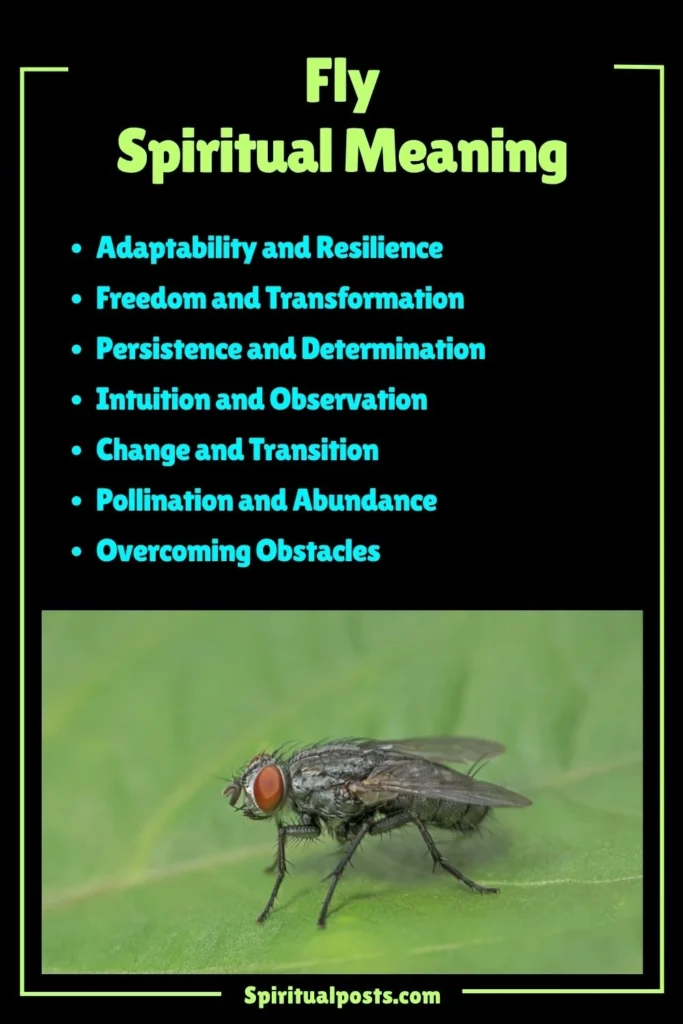
The fly, a small yet resilient insect, has long held a place in human history and mythology, with its spiritual meanings and symbolism intriguing and often misunderstood.
Ubiquitous in nature, the fly’s presence has been noted across cultures, religions, and belief systems, each interpreting its significance through a unique lens.
From ancient Egyptian hieroglyphs to modern-day folklore, the fly has been imbued with a multitude of symbolic associations. Its ability to thrive in a variety of environments, its persistent nature, and its role as a pollinator have all contributed to its complex and sometimes contradictory spiritual meanings.
Whether seen as a harbinger of change, a symbol of persistence, or a representation of the soul’s journey, the fly’s presence in our lives invites us to ponder the deeper significance of this humble, yet fascinating creature.
As we delve into the spiritual meanings of the fly, we uncover a world of insight and understanding that transcends its physical form.
What Does It Mean When You See a Fly ?
When you see a fly, it may symbolize a range of spiritual meanings, each dependent on the context and your personal interpretations.
Flies are often associated with death, decay, and transformation, as they’re commonly found around rotting matter. In this sense, a fly’s appearance may signify the need to address unresolved issues or let go of something that’s no longer serving you.
Alternatively, flies can represent persistence, resilience, and the ability to thrive in challenging environments. Their quick adaptability and survival instincts may encourage you to approach obstacles with a similar tenacity.
Additionally, flies are sometimes seen as messengers, carrying information or insights that you need to pay attention to. Their presence may prompt you to be more observant and tune into the subtle energies around you.
Ultimately, the spiritual significance of a fly will depend on your own intuition and the circumstances in which it appears.
Fly Symbolism
In the realm of symbolism, flies can represent a myriad of interpretations, often reflective of your personal experiences and spiritual outlook. The humble fly, often overlooked, can serve as a powerful metaphor in your journey of self-discovery and spiritual growth.
Persistence and resilience: The fly’s ability to bounce back from adversity and its unwavering determination to achieve its goals can symbolize your own capacity for perseverance and inner strength.
Transformation and rebirth: The fly’s lifecycle, which includes a remarkable metamorphosis from larva to adult, can represent your own personal growth and the process of shedding old patterns to embrace new beginnings.
Attention to detail: The fly’s keen senses and its ability to detect even the slightest changes in its environment can remind you to pay closer attention to the subtle nuances in your life and the world around you.
Adaptability and flexibility: The fly’s agility and its capacity to thrive in a wide range of environments can symbolize your own ability to navigate the ebbs and flows of life with grace and adaptability.
7 Spiritual Meanings of Fly
As you explore the spiritual meanings of the fly, you’ll discover insights into your own adaptability, resilience, and freedom.
The persistent presence of the fly can also symbolize your determination, intuition, and ability to navigate change and transition.
Embracing the lessons of the fly can empower you to transform and evolve, unlocking new perspectives and growth opportunities.
Adaptability and Resilience
The fly’s uncanny ability to adapt and thrive in diverse environments underscores its symbolic significance as a representation of resilience. Whether navigating the complexities of your personal life or facing challenges in your career, the fly’s example can offer valuable lessons.
Flies can react and adjust to changes in their surroundings with lightning-fast reflexes, a skill that allows them to deftly avoid threats and seize opportunities.
They flourish in a wide range of habitats, from bustling cities to remote wilderness, demonstrating an impressive capacity to thrive in diverse environments.
Flies persistently return, undeterred by efforts to deter them, embodying an unwavering determination to overcome obstacles.
With their short lifespans, flies continually renew themselves, exemplifying the power of adaptation and growth in the face of constant change.
Embrace the fly’s spirit of adaptability and resilience, and let it inspire you to navigate life’s ups and downs with agility and tenacity.
Freedom and Transformation
Flies’ remarkable ability to navigate between realms symbolizes the spiritual significance of freedom and transformation. As ubiquitous creatures, flies deftly move through the physical world, crossing boundaries with ease. This fluidity reflects the spiritual journey of transcending limitations and embracing new perspectives.
The fly’s metamorphosis from larva to adult embodies the concept of personal growth and rebirth. Just as a fly emerges from its cocoon, shedding its former self, humans are called to shed outdated beliefs and patterns, allowing for a profound inner change. This process of transformation can be both exhilarating and challenging, but the fly reminds us that it’s a natural part of the spiritual path.
Furthermore, the fly’s freedom of movement symbolizes the liberation of the soul. Its ability to soar through the air, unencumbered by earthly constraints, reflects the human desire for autonomy and the transcendence of physical limitations. By embracing the fly’s energy, we can cultivate a sense of spiritual independence and openness to new possibilities.
Persistence and Determination
Alongside the fly’s symbolism of freedom and transformation, its unwavering persistence and determination hold profound spiritual significance. You need only observe a fly’s relentless efforts to land on a surface, undeterred by obstacles or human interference, to recognize the power of this small creature’s drive and resilience.
The fly’s spiritual meaning of persistence and determination can be seen in several ways:
- Adaptability: Flies are known for their ability to adapt to a wide range of environments and conditions, thriving even in the face of adversity.
- Tenacity: The fly’s refusal to give up, even when faced with repeated setbacks, serves as a reminder of the importance of persevering through life’s challenges.
- Resilience: The fly’s ability to bounce back from near-death experiences, such as being swatted or trapped, symbolizes the human capacity for overcoming seemingly insurmountable obstacles.
- Determination: The fly’s single-minded focus on its goals, whether it’s finding a food source or a mate, embodies the spiritual significance of unwavering determination.
Intuition and Observation
Your intuition and keen observation skills are crucial in unlocking the spiritual meanings of the fly. As you attentively watch the fly’s intricate movements and behaviors, you’ll discover profound insights about your own life journey.
The fly’s ability to navigate its environment with such agility and swiftness represents your own capacity for adaptability and responsiveness. Observe how the fly effortlessly maneuvers through the air, seemingly guided by an innate intelligence. This can symbolize your own intuitive understanding of the ebbs and flows of life, allowing you to seamlessly adapt to changing circumstances.
The fly’s propensity to land on various surfaces and objects reflects your own willingness to explore different perspectives and possibilities. Its persistent and determined nature serves as a reminder to stay focused and committed to your goals, no matter the obstacles that arise.
Change and Transition
Embracing the fly’s presence can signify impending changes and transitions in your life, urging you to remain open and adaptable to the transformations ahead. The fly’s ability to navigate with agility and grace can represent your own capacity to gracefully adapt to the shifting circumstances you may encounter.
Consider the following ways the fly’s symbolism can guide you through periods of change and transition:
Flexibility: The fly’s nimble movements demonstrate the importance of maintaining a flexible mindset, allowing you to easily navigate unexpected twists and turns.
Resilience: The fly’s persistence in the face of obstacles can inspire you to cultivate resilience, enabling you to bounce back from challenges.
Alertness: The fly’s keen senses and quick reflexes can remind you to stay alert and attuned to the subtle signs of change around you.
Transformation: The fly’s complete metamorphosis from larva to adult can symbolize the profound transformations you may experience during times of transition.
Embracing the lessons of the fly can empower you to approach change with grace, adaptability, and a renewed sense of purpose.
Pollination and Abundance
The fly’s role as a pollinator can symbolize the spiritual abundance that may flow into your life, as it carries pollen from blossom to blossom, facilitating the cycle of growth and renewal. Just as the fly’s movements from flower to flower enable the fertilization and propagation of plant life, the presence of flies in your life can represent the potential for spiritual nourishment and manifestation.
Flies are often associated with the element of air, which is linked to the realm of the mind and spirit. As pollinators, they play a vital role in the natural world, ensuring the continuation of plant species and the overall abundance of the ecosystem.
In a similar way, the fly’s spiritual symbolism can signify the importance of allowing new ideas, perspectives, and opportunities to flow into your life, enabling you to experience a sense of spiritual fulfillment and prosperity.
Furthermore, the fly’s adaptability and resilience can be seen as a reminder to remain flexible and open to the ebb and flow of life’s cycles, embracing the changes that may lead to greater spiritual abundance and growth.
Overcoming Obstacles
Just as flies persist in the face of adversity, their presence can signify your ability to overcome obstacles and challenges on your spiritual journey. Flies are resilient creatures that can thrive in even the most inhospitable environments, symbolizing your capacity to adapt and persevere through difficult circumstances.
When flies appear in your life, they may be encouraging you to tap into your own inner strength and determination.
Flies are masters of adaptation, able to quickly adjust to changing conditions. This can inspire you to approach challenges with flexibility and an open mind.
Flies are relentless in their pursuit of their goals, never giving up in the face of adversity. This can motivate you to stay the course and persevere through your own difficulties.
Flies can withstand a wide range of physical stresses, symbolizing your ability to bounce back from setbacks and emerge stronger.
Flies are adept at finding creative solutions to their problems, which can encourage you to approach your own obstacles with innovative thinking.
Fly Symbolism in Different Cultures and Contexts
Fly symbolism has long been explored across various cultures and contexts.
From the reverence of the fly in Native American traditions to its association with death in Celtic folklore, the fly’s representation extends far beyond its physical form.
Delving into the meanings and interpretations of the fly in diverse cultural and spiritual frameworks can provide deeper insights into humanity’s enduring fascination with these ubiquitous insects.
Native American Culture
In Native American cultures, fly symbolism often embodies transformation and the cyclical nature of life, inspiring profound contemplation of the divine. The humble fly is seen as a reminder of the ever-changing rhythms of existence, with its short lifespan and constant motion mirroring the fleeting, yet perpetual, cycles of birth, death, and rebirth.
Within this context, the fly can represent:
- Adaptability and resilience, as it navigates the complexities of the world with ease and persistence.
- The interconnectedness of all things, with the fly serving as a bridge between the earthly and the spiritual.
- The importance of paying attention to the small and seemingly insignificant, for within these details lie profound teachings.
- The constant state of transformation, as the fly undergoes its own metamorphosis from larva to adult.
Through the lens of Native American spirituality, the fly encourages us to embrace the fluid nature of life, to find wisdom in the most unexpected places, and to honor the sacredness of all creation.
Celtic Culture
While Native American cultures viewed the fly through a lens of transformation and divine connection, Celtic spirituality often imbued the humble insect with associations of mischief, trickery, and the otherworldly.
In the rich tapestry of Celtic mythology, the fly was frequently seen as a shapeshifter, a trickster figure that could move fluidly between the mortal and spiritual realms.
The Celtic god Lugh, celebrated for his mastery of various arts and skills, was sometimes depicted with a fly as his companion, symbolizing the deity’s ability to perceive the world from multiple perspectives.
Additionally, the fly was believed to be a messenger from the Otherworld, carrying wisdom and insights from the realm of the supernatural.
Celtic folklore is rife with tales of mischievous fairies and spirits that would take the form of flies, using their nimble flight and shape-shifting prowess to play tricks on unsuspecting humans.
Nordic Culture
Nordic cultures, like their Celtic counterparts, often viewed the fly through a lens of duality – at once a harbinger of mischief and a conduit to the otherworldly. In the Norse mythological tradition, the fly was closely associated with the trickster god Loki, known for his cunning and disruptive behavior.
However, the fly’s symbolic significance extended beyond mere mischief. The Norse people believed that flies were capable of revealing hidden truths and serving as messengers between the physical and spiritual realms.
This belief manifested in several ways:
- Flies were sometimes seen as the manifestation of ancestral spirits, carrying messages from the dead to the living.
- Certain types of flies, such as the blue bottle fly, were thought to have the ability to predict the weather and foretell the changing of the seasons.
- The presence of flies was often interpreted as a sign of the gods’ or spirits’ watchful gaze, a reminder of the unseen forces at work in the world.
- In some Nordic tales, flies were depicted as shapeshifting entities, capable of transforming into other animals or even human form.
African Culture
Across diverse African cultures, the fly often symbolizes resilience, adaptability, and the cycle of life and death. In many belief systems, the fly’s persistent nature and ability to thrive in a wide range of environments are seen as a reflection of the enduring human spirit. The fly’s presence is sometimes interpreted as a connection to the spiritual realm, with the insect acting as a messenger or intermediary between the physical and metaphysical worlds.
Additionally, the fly’s role in the decomposition of organic matter is often viewed as a symbol of transformation and the inevitable process of change. In some traditions, flies are associated with the honoring of ancestors, as they’re believed to carry the spirits of the departed. This symbolism can be seen in rituals and ceremonies that incorporate the presence of flies.
Ultimately, the fly’s multifaceted symbolism in African cultures speaks to the deep-rooted reverence for the natural world and the cyclical nature of existence.
Eastern Culture
In Eastern cultures, the fly’s symbolism often differs from its representation in African traditions. You’ll find that the fly can signify both positive and negative concepts, depending on the specific cultural context.
For instance, in Hinduism, the fly is associated with the god Ganesha, who’s believed to remove obstacles and bring prosperity. The fly’s ability to land on various surfaces is seen as a symbol of Ganesha’s adaptability and versatility.
Conversely, in some Buddhist traditions, the fly represents impurity, as it’s drawn to filth and decay.
The fly’s symbolism in Eastern cultures includes:
- Persistence and determination: The fly’s unwavering efforts to land on a surface, despite obstacles, represent perseverance and resilience.
- Impermanence: The fly’s short lifespan is seen as a metaphor for the fleeting nature of existence.
- Spiritual transformation: In some beliefs, the fly’s ability to metamorphose from a larva to an adult symbolizes the journey of spiritual enlightenment.
- Detachment: The fly’s indiscriminate landing on both clean and unclean surfaces is interpreted as a lesson in non-attachment and equanimity.
Hindu Culture
Hinduism’s reverence for the fly stems from its association with the elephant-headed deity Ganesha, who’s believed to remove obstacles and bring prosperity. In Hindu mythology, Ganesha is often depicted with a small fly or insect on his person, symbolizing his ability to overcome even the most minuscule of challenges.
The fly’s agility and resilience are seen as attributes to be emulated, as it persistently navigates through life’s obstacles.
Moreover, the fly’s role as a scavenger is also significant in Hindu thought. It’s believed that the fly’s capacity to find sustenance in even the most undesirable of places reflects the divine’s capacity to find good in all things. This perspective encourages Hindus to approach life with an open mind and a willingness to find the positive, even in the most challenging circumstances.
Ultimately, the fly’s prominence in Hindu iconography and philosophy underscores the culture’s deep appreciation for the lessons that can be gleaned from even the most seemingly insignificant of creatures.
Arts and Literature
While Hinduism’s reverence for the fly stems from its association with the elephant-headed deity Ganesha, you’ll find that the fly’s symbolism extends far beyond the Indian subcontinent, appearing in diverse artistic and literary works across cultures and contexts. The fly’s significance in arts and literature often reflects the complex and multi-faceted nature of this humble insect.
In ancient Egyptian mythology, the fly was a symbol of rebirth and regeneration, featured prominently in the hieroglyphics and tomb paintings. Likewise, in Greek mythology, the fly was linked to the god Beelzebub, representing the persistence and resilience of life.
Some key ways the fly is represented in arts and literature include:
- As a metaphor for the persistence of life, as seen in William Shakespeare’s ‘Hamlet’ and John Milton’s ‘Paradise Lost.’
- As a symbol of decay and corruption, as depicted in the works of 17th-century Dutch masters like Hieronymus Bosch.
- As a representation of the fragility of human existence, as explored in the writings of Franz Kafka.
- As a motif of the inescapable nature of mortality, as evident in the poetry of Emily Dickinson.
Mythology
Beyond Hinduism’s reverence, you’ll find the fly’s symbolic significance spans diverse mythologies worldwide. In Egyptian lore, the insect embodied rebirth and perseverance, while Greek myth linked it to the persistent god Beelzebub. The fly’s association with death and decay in many cultures reflects its scavenging nature, yet this very trait also symbolizes transformation and the cycle of life.
In Norse mythology, the fly represented cunning and the ability to access hidden knowledge. Similarly, Celtic traditions saw the creature as a guide to the Otherworld, able to traverse realms unseen by humans.
The fly’s capacity to thrive in both clean and unclean environments has endowed it with dualistic meanings – a messenger of both good and evil, life and death.
Across diverse belief systems, the fly’s ubiquity, adaptability, and resilience have imbued it with a rich tapestry of symbolic resonance, from the divine to the demonic, the regenerative to the repulsive.
Fly Biblical Meanings
The fly holds significant biblical meanings, with various passages in the scriptures referencing its symbolic significance. From ancient times, the fly has been associated with a range of spiritual concepts, serving as a metaphor for both positive and negative aspects of human nature.
In the Book of Exodus, flies are used as a plague to symbolize the impurity and sinfulness that can corrupt the human soul (Exodus 8:21-24).
The fly is sometimes associated with the presence of evil, as it can represent the temptations and deceptions that lure people away from righteous living (Ecclesiastes 10:1).
Despite their small size, flies are known for their tenacity and ability to thrive in a variety of environments, mirroring the resilience and endurance that believers are called to exhibit (2 Corinthians 12:7-9).
The fly’s humble stature can serve as a reminder of the need for humility and an acknowledgment of our own insignificance in the grand scheme of God’s creation (Job 25:6).
Spiritual Meaning of Dream About Fly
Dreams about flies can offer profound spiritual insights, reflecting your inner struggles, temptations, or the need for purification in your life. The fly is often seen as a symbol of unwanted and persistent thoughts, feelings, or behaviors that you’re having difficulty managing. Its presence in your dreams may indicate that you’re dealing with negative influences or distractions that are preventing you from achieving your spiritual goals.
Alternatively, the fly can represent a need for greater discernment and vigilance in your life. Just as a fly is drawn to unclean or unhealthy conditions, the dream may be prompting you to examine areas of your life that require cleansing or purification. This could involve letting go of unhealthy habits, releasing negative emotions, or setting boundaries to protect your spiritual well-being.
Ultimately, the spiritual meaning of a dream about a fly will depend on the specific context and your personal experiences. By reflecting on the details of the dream and tuning into your intuition, you can gain valuable insights to support your spiritual growth and development.
Fly Spirit Animal, Totem, and Power Animal
If you feel drawn to the fly as a spirit animal, it may be urging you to pay closer attention to the persistent thoughts, feelings, or behaviors that are interfering with your spiritual growth. As a totem, the fly can symbolize the need for discernment, vigilance, and a willingness to confront unpleasant aspects of yourself or your life.
The fly spirit animal may be guiding you to:
- Increase your awareness of the small details and subtleties that often go unnoticed.
- Cultivate a sharp, observant mind that can quickly identify and address problems.
Develop persistence and resilience in the face of adversity or setbacks.
Embrace the ability to transform and reinvent yourself, much like the fly’s life cycle.
A Final Note
The fly’s remarkable adaptability and perceptive nature make it a powerful spiritual symbol.
By embracing the lessons the fly offers, you can cultivate a more flexible mindset, deepen your connection to the natural world, and gain valuable insights into the cycles of transformation and rebirth that govern our lives.
Engaging with the fly’s symbolism can help you navigate change and find your place within the larger rhythms of the universe.


