Ymir Spiritual Meaning, Symbolism and Cultural Significance
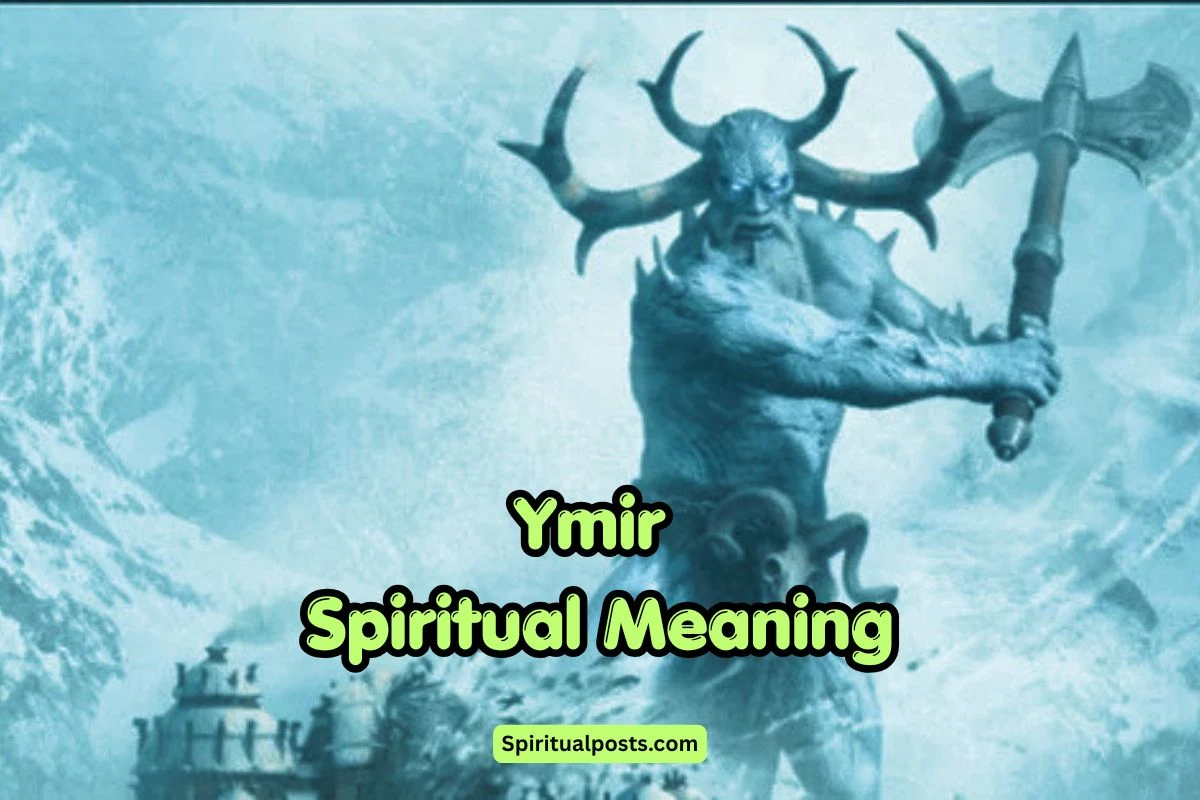
In the primordial realm of Norse mythology, Ymir stands as a towering figure, a primordial being whose very existence embodies the cyclical nature of the cosmos. When you encounter Ymir, you find yourself at a crossroads, called to confront the chaos that lies at the heart of transformation. Ymir’s symbolism speaks to the duality of life and death, inviting you to embrace the paradoxes that lie at the core of your spiritual journey. Delve deeper into the spiritual meanings and rich symbolism of Ymir, and you just might uncover the key to unlocking a deeper understanding of your place within the grand tapestry of existence.
Key Takeaways
- Ymir represents the primordial chaos from which the ordered universe emerged, embodying the duality of life and death, destruction and rebirth.
- Encountering Ymir can symbolize a time of transition and the need to confront the unknown, embracing the transformative power within the chaotic.
- Ymir’s symbolism speaks to the cyclical nature of existence, where the dismemberment and fashioning of the world from its primal parts illustrate the interplay of order and disorder.
- Ymir parallels progenitor figures in various world mythologies, such as Brahma in Hinduism, highlighting the universality of the primordial, world-generating entity archetype.
Introduction to Ymir
Ymir, the primordial being from Norse mythology, represents the fundamental origins of the cosmos and all living creatures. As the first giant, Ymir‘s existence is inextricably linked to the very foundation of the universe.
According to the ancient Norse texts, Ymir emerged from the primordial void, the formless chaos that existed before the creation of the world. From Ymir’s body, the various elements of the universe were formed, including the earth, the sky, and the first living beings.
Ymir’s significance extends beyond the physical aspects of creation; the figure also embodies profound spiritual and symbolic meanings. As the progenitor of all existence, Ymir symbolizes the duality of life and death, the cycle of destruction and rebirth that’s central to many belief systems.
Additionally, Ymir’s connection to the elemental forces of the universe, such as ice and fire, represent the balance and harmony that underlie the natural world. By understanding Ymir’s role in Norse cosmology, we can gain deeper insights into the spiritual and philosophical underpinnings of this rich cultural tradition.
What Does It Mean When You See a Ymir ?
Encountering the primordial figure of Ymir in your spiritual journey can hold profound significance, offering insights into the cyclical nature of existence and the balance that underlies the natural world.
Ymir, the primal being from Norse mythology, represents the primordial chaos from which the cosmos emerged. When you encounter this archetypal symbol, it may signify a time of transition, a need to confront the unstructured and chaotic aspects of your life, or an invitation to tap into the fundamental creative forces that underpin the universe.
Seeing Ymir can symbolize the dissolution of old structures, allowing for the birth of something new. It may encourage you to release control, embrace the unknown, and surrender to the natural flow of life.
Contemplating Ymir’s role in the creation of the world can also inspire a deeper appreciation for the interconnectedness of all things, reminding you of the cyclical nature of existence and the perpetual dance between order and chaos. Engaging with the meaning of Ymir can guide you towards a more holistic understanding of your spiritual path and your place within the grand tapestry of the cosmos.
Ymir Symbolism
The symbolism of Ymir transcends the physical realm, inviting you to delve into the profound mysteries of creation and the eternal dance between order and chaos. In Norse mythology, Ymir represents the primordial giant from whose body the world was formed. This colossal figure embodies the primal forces of nature, both generative and destructive, which underpin the very foundations of the cosmos.
Ymir’s dual nature symbolizes the inherent duality within the universe, where light and dark, life and death, are intertwined. The dismemberment of Ymir and the fashioning of the world from his body parts illustrate the idea that from chaos, order emerges.
This powerful metaphor speaks to the cyclical nature of existence, where destruction gives rise to new creation. Contemplating the symbolism of Ymir can inspire you to embrace the paradoxes of life, to find harmony in the interplay of opposing forces, and to recognize the transformative power that lies within the depths of the unknown.
7 Spiritual Meanings of Ymir
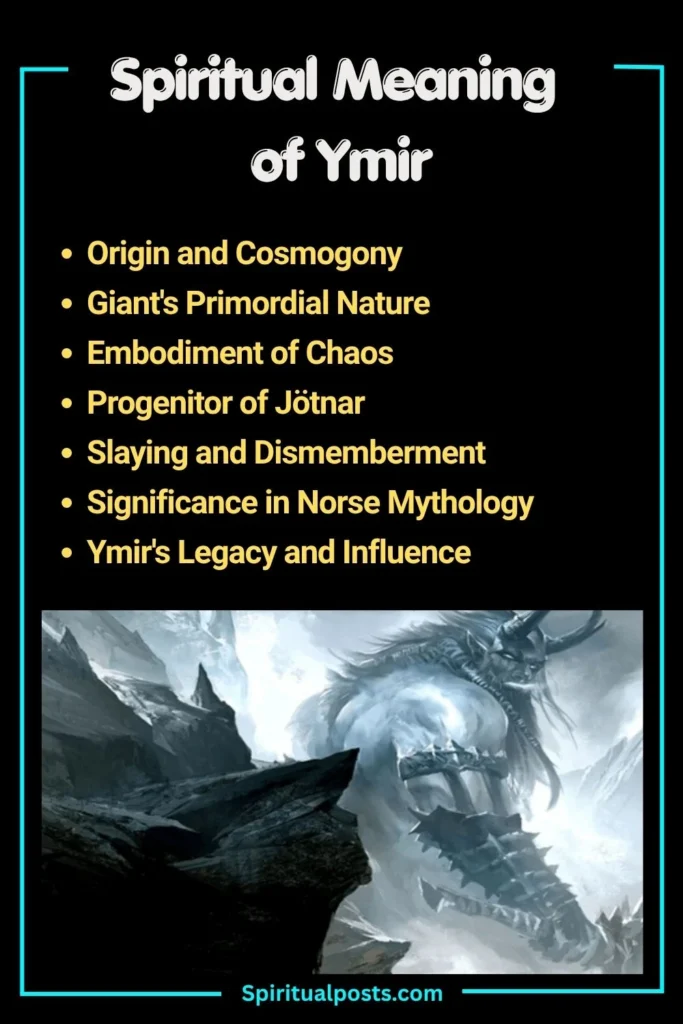
As the primordial being, Ymir represents the chaotic origins of the universe. This giant embodies the primal state of existence before the cosmos was shaped and ordered.
Origin and Cosmogony
According to Norse mythology, Ymir’s origin is inextricably linked to the very fabric of the cosmos, serving as a primordial figure central to the creation of the world.
In the beginning, there was only the vast, empty void known as Ginnungagap, where the icy realm of Niflheim to the north met the fiery realm of Muspelheim to the south. From the meeting of these two opposing forces, the giant Ymir was born, a being of both ice and fire, embodying the primal chaos that existed before the order of the cosmos.
Ymir is said to have been nourished by the primordial cow, Audhumla, whose milk sustained the giant. As Ymir slept, the first of the gods, Búri, emerged from the melting ice, eventually giving rise to Odin and the other Aesir deities who’d go on to shape the world as we know it.
Ymir’s body was then used by the gods to create the various elements of the universe, demonstrating the deep interconnectedness between the giant and the cosmogonic process.
Giant’s Primordial Nature
Ymir’s primordial nature embodies the raw, primal energies that gave rise to the very fabric of the cosmos, symbolizing the chaotic forces from which order emerged. As the first being in Norse cosmology, Ymir represents the unformed, undifferentiated state of existence prior to the creation of the worlds. This giant’s body, formed from the intermingling of fire and ice, encapsulates the fundamental duality at the heart of the universe – the interplay of opposing elements that gave birth to all things.
In this way, Ymir’s nature is deeply symbolic, representing the potent, undirected power from which the ordered realms of the Norse cosmos would eventually coalesce. Ymir’s dismemberment and the subsequent formation of the world from his body parts further emphasize this idea, as the disparate parts of the primordial giant are transformed into the structured components of the nine worlds. The giant’s primordial essence thus serves as a powerful metaphor for the generative, creative forces that underpin the entire Norse cosmological narrative.
Embodiment of Chaos
The primal chaos-giant Ymir embodies the raw, undifferentiated energies from which the ordered realms of the Norse cosmos eventually emerged. As the first being to exist, Ymir represents the primordial state of the universe before the gods shaped it into its current form. In this sense, Ymir is the embodiment of the elemental chaos that predates the manifestation of distinct forms and entities.
Ymir’s monstrous, amorphous nature symbolizes the formless, unpredictable forces that existed before the cosmos was structured and organized. From Ymir’s very flesh and blood, the gods created the various aspects of the world, including the land, the sky, and the celestial bodies. This underscores Ymir’s role as the primal wellspring from which all of creation springs forth.
At the same time, Ymir’s violent demise at the hands of the gods also signifies the necessity of order emerging from chaos. The Norse myths suggest that some degree of structured, directed power must arise to bring coherence and stability to the primordial confusion represented by Ymir.
Progenitor of Jötnar
From Ymir’s body, the Jötunn – the primordial giants of Norse mythology – were born, forming a powerful lineage that would play a crucial role in the cosmological drama that unfolded. As the progenitor of this formidable race, Ymir’s significance extends far beyond his embodiment of chaos.
The Jötunn, often depicted as wild, unruly, and untamed, were descendants of this ur-giant, inheriting his elemental power and untamed nature. Through the Jötunn, Ymir’s legacy continued to shape the Norse cosmos, as these giants challenged the gods and upheld the forces of nature against the order and civilization represented by the Æsir.
Ymir’s offspring, from the monstrous Fenrir wolf to the terrifying Jörmungandr serpent, embodied the raw, primal energies that threatened to unravel the delicate balance of the nine worlds. In this way, Ymir’s role as the progenitor of the Jötunn imbued him with a profound spiritual significance, as he represented the untamed, chaotic forces that constantly threatened to overwhelm the established order.
Slaying and Dismemberment
Intricately linked to Ymir’s role as the progenitor of the Jötnar is the profound spiritual significance of his slaying and dismemberment, a pivotal event in Norse cosmology that gave rise to the very world we inhabit.
According to the Norse creation myth, the god Odin, along with his brothers Vili and Vé, slew the mighty Ymir, then proceeded to fashion the material universe from his dismembered body.
From Ymir’s flesh, they crafted the earth; from his blood, the seas and rivers; from his bones, the mountains; and from his skull, the heavens.
This cosmogonic act of dismemberment and transformation not only gave birth to the physical world, but also imbued it with deeper spiritual symbolism.
Ymir’s body, as the primordial source of creation, represents the interconnectedness of all things, the cyclical nature of life and death, and the profound mystery at the heart of existence.
His violent end, at the hands of the gods, speaks to the delicate balance between order and chaos, the necessity of change, and the often-unseen forces that shape the cosmos.
Symbolic Significance in Norse Mythology
Beyond the tangible transformation of Ymir’s body into the physical world, Norse mythology imbues his dismemberment with profound spiritual symbolism that illuminates the very fabric of existence. Ymir, the primal giant from whom the cosmos was formed, represents the primordial chaos from which order emerged. His division into distinct elements – earth, sky, sea, and so on – signifies the separation of these fundamental aspects of the universe.
This symbolic act of division is crucial, as it reflects the Norse belief that creation arises from the fragmentation of the primordial whole.
Just as Ymir’s body was sundered to form the different realms, so too does the spiritual realm emerge from the dissolution of the undifferentiated. In this way, Ymir’s dismemberment suggests that the very structure of reality is predicated on the shattering of unity, a necessary precursor to the manifestation of the diverse forms that constitute the cosmos.
This powerful metaphor underscores the Norse worldview, where creation is inextricably linked to the sundering of the primal.
Ymir’s Legacy and Influence
The profound spiritual symbolism inherent in Ymir’s dismemberment has profoundly shaped Norse cosmology, influencing how adherents of this ancient tradition perceive the very nature of existence. Ymir’s body, from which the world was fashioned, represents the primordial chaos from which order was born. His decapitation and the subsequent crafting of the heavens and earth from his various body parts symbolize the divine act of creation, where the formless void was shaped into the structured universe.
This grisly act of dismemberment is rich with deeper meanings, signifying the transformation of the primeval into the manifest, the unformed into the formed. Ymir’s blood becoming the seas, his bones the mountains, and his skull the dome of the sky are potent metaphors for the emergence of the physical world from the metaphysical realm.
The enduring legacy of Ymir’s symbolic significance can be seen in the way Norse mythology continues to inform our understanding of the interplay between chaos and order, the material and the spiritual. Its profound insights still resonate with those seeking to comprehend the mysteries of the cosmos.
Ymir Symbolism in Different Cultures and Contexts
In exploring the symbolism of Ymir, it’s fascinating to see how this mythical figure has resonated across diverse cultures.
From Native American traditions to Celtic lore, Nordic mythology, African spiritual beliefs, and Eastern philosophies, Ymir’s influence can be found woven throughout these rich tapestries of human experience.
Let’s delve into the intriguing ways this primordial being has been interpreted and understood in various cultural contexts.
Native American Culture
Across Native American cultures, you’ll find intriguing connections between Ymir’s mythological symbolism and their own rich spiritual traditions. Many tribes saw powerful parallels between the primordial giant and their own cosmological understandings.
For example, the Lakota people viewed Ymir as akin to their own Great Spirit, the ultimate creative force from which all life emerged. Similarly, the Hopi believed that Ymir’s dismemberment mirrored their own creation story, where the world was formed from the body of a primal being.
Beyond these broad thematic links, you’ll also discover more specific symbolic resonances. The Navajo saw Ymir’s icy body as a metaphor for the harsh, unyielding forces of nature that their people had to contend with.
Meanwhile, the Iroquois interpreted Ymir’s giantism as a symbol of the grandeur and power of the natural world, which their spiritual traditions sought to revere and protect. Across these diverse cultural contexts, Ymir’s mythos found powerful echoes, underscoring the universal human need to make sense of our origins and our place in the cosmos.
Celtic Culture
While Native American cultures saw compelling parallels between Ymir’s mythos and their own spiritual worldviews, Celtic traditions offer a distinct yet equally intriguing interpretation of the primordial giant‘s symbolic significance.
In the Celtic cosmology, Ymir is often associated with the concept of the ‘Cosmic Tree,’ a sacred symbol representing the interconnectedness of all things. The giant’s body is seen as the primordial source from which the natural world, including the heavens and the earth, emerged and evolved.
His dismemberment by the gods is interpreted as the division of this primordial unity into the distinct elements and forms that make up the physical universe.
The Celtic understanding of Ymir also emphasizes the idea of cyclical renewal, with the giant’s remains serving as the raw materials for the ongoing process of creation and regeneration. This cyclical worldview is reflected in Celtic myths and legends, where death and rebirth are central themes.
Ultimately, Ymir’s role in Celtic spirituality underscores the profound respect and reverence these ancient cultures held for the natural world and its underlying mysteries.
Nordic Culture
Building on the fascinating Celtic interpretations of Ymir’s symbolism, we now turn our attention to how the Nordic cultures understood and revered this primordial giant.
The Nordic worldview saw Ymir as the very foundation upon which the cosmos was constructed, with his body serving as the raw material from which the gods fashioned the realms of heaven and earth.
In Norse mythology, Ymir was the first being, an immense, hermaphroditic frost giant from whose body the gods created the world. From his flesh, they made the earth; from his blood, the seas; from his bones, the mountains; and from his skull, the heavens. The gods then banished Ymir’s offspring, the other frost giants, to the edges of the world, where they became symbolic of the untamed, chaotic forces that existed beyond the ordered realms of the gods.
Ymir’s centrality to the Nordic creation story underscores the deep spiritual significance he held in these cultures. As the primordial ancestor, he represented the raw, primal essence from which all of existence was formed, a powerful symbol of the generative, life-giving forces at the heart of the cosmos.
African Culture
Though Ymir’s mythological origins lie firmly within the Nordic cultures, his symbolic significance has resonated across diverse African spiritual traditions as well. These ancient African worldviews often drew parallels between Ymir’s primordial status and their own cosmogonic narratives, finding common ground in the notion of a primal, generative entity from which the ordered universe emerged.
In many African belief systems, the concept of a primordial giant or progenitor figure akin to Ymir played a central role in their creation myths. For instance, the Dogon people of West Africa spoke of a primordial being named Amma, whose body was the source of all existence. Similarly, the Igbo of Nigeria venerated Chineke, a supreme deity who manifested as the original, undifferentiated substance from which the world was formed.
These parallels suggest that the archetype of a primordial, world-generating entity holds deep resonance across cultural boundaries, transcending the specific Nordic origins of Ymir’s mythology.
Eastern Culture
The symbolic significance of Ymir extends beyond the Nordic pantheon, manifesting in Eastern spiritual traditions as well. In Chinese cosmology, for instance, the concept of Pangu – a primordial giant whose body formed the elements of the universe – bears striking resemblance to the Nordic myth of Ymir.
Similarly, in Hindu mythology, the deity Brahma is believed to have emerged from the cosmic waters, much like Ymir’s birth from the melting ice. These parallels suggest a shared archetypical understanding of creation and the origin of the world across diverse cultural contexts.
Moreover, the notion of a primal, elemental being whose very substance gives rise to the physical world is a recurring theme in many Eastern philosophies. In Taoism, the concept of Tai Chi, the ultimate source of all things, echoes the generative power attributed to Ymir.
Likewise, in Buddhist teachings, the idea of the primordial Buddha, or Adi-Buddha, as the foundation of existence resonates with the Nordic vision of Ymir as the primeval ancestor of all.
Hindu Culture
In the rich tapestry of Hindu mythology, the parallels between Ymir and the creator deity Brahma are equally captivating. Brahma’s emergence from the cosmic waters, much like Ymir’s birth from the melting ice, suggests a shared understanding of creation and the origin of the world across these diverse cultural traditions.
Just as Ymir’s body gave rise to the various elements of the Norse cosmos, Brahma’s act of self-division is believed to have birthed the gods, the universe, and all living beings. The symbolic connection between these progenitor figures extends to their roles as the primordial sources from which all existence flows.
In Hindu belief, Brahma’s four heads represent the four Vedas, the foundational scriptures of the tradition, while Ymir’s multifaceted nature mirrors the intricate web of mythological and cosmological concepts within Norse mythology.
Exploring these resonances illuminates the universal human desire to understand the mysteries of creation, and the diverse ways in which cultures have sought to give voice to these profound questions.
Arts and Literature
Across diverse artistic and literary traditions, Ymir’s mythic symbolism has captivated audiences, inspiring myriad creative interpretations that reflect the primal power of this Norse figure.
In the visual arts, Ymir’s colossal form has been depicted in intricate woodcarvings, stone sculptures, and dynamic paintings, often showcasing the primordial giant’s role as the primeval source from which the cosmos emerged.
Poetic and narrative works have similarly explored the profound implications of Ymir’s existence, weaving tales that delve into the underlying themes of creation, destruction, and the cyclical nature of existence.
From the ancient Eddas to modern fantasy literature, Ymir’s presence serves as a touchstone for explorations of the human condition, the natural world, and the mysteries of the divine.
Across these diverse creative expressions, the enduring appeal of Ymir lies in the character’s capacity to embody the fundamental forces that shape our understanding of the universe and our place within it.
Mythology
Beyond the artistic and literary realms, you’ll find that Ymir’s mythic symbolism has resonated across diverse cultural traditions, often serving as a touchstone for profound explorations of the human experience and the natural world.
In Norse mythology, Ymir, the primordial giant, represents the primal chaos from which the cosmos was born, an embodiment of the raw materials that gave rise to the ordered universe. His dismemberment and the subsequent creation of the world from his body parts symbolize the transformation from primordial disorder to structured existence. This powerful metaphor has been interpreted as a commentary on the cyclical nature of creation and destruction, the interplay between chaos and order, and the fundamental forces that govern the natural world.
Likewise, in Hinduism, the figure of Purusha, a cosmic man whose sacrifice led to the formation of the universe, shares intriguing parallels with the Norse Ymir, highlighting the universality of such mythic archetypes.
As you delve deeper into the rich tapestry of Ymir’s symbolic significance, you’ll uncover a wealth of insights into the human condition and our place within the grand cosmic dance.
Ymir Biblical Meanings (with relevant bible verses)
Ymir’s biblical meanings draw intriguing parallels to Scriptural accounts, inviting readers to ponder the interplay between mythological and religious themes. In the Old Testament, the primordial giant Ymir finds echoes in the figure of Leviathan, the monstrous sea creature mentioned in the Book of Job. Like Ymir, Leviathan is a primal, chaotic entity that represents the forces of disorder and opposition to the divine order.
Furthermore, the act of Odin and his brothers slaying Ymir and using his body to create the world bears striking similarities to the biblical account of God’s creation of the universe from the primeval waters.
Delving deeper, Ymir’s association with ice and frost can be interpreted as a symbolic representation of the hardness of the human heart, which must be melted by the warmth of divine grace. The notion of the cosmos emerging from the dismembered body of a primordial being also evokes the Christian concept of new life springing forth from sacrifice and death.
While the parallels aren’t exact, the mythological figure of Ymir invites reflections on the shared themes of creation, chaos, and the struggle between order and disorder that resonate in both pagan and Judeo-Christian traditions.
Spiritual Meaning of Dream About Ymir
If you dream of the primordial giant Ymir, it may symbolize the primal forces of chaos and disorder within your own psyche that you must confront and overcome. Ymir, the first being in Norse mythology, represents the raw, untamed power of the natural world before the creation of the ordered cosmos. In your dream, Ymir may appear as a towering, formidable figure, embodying the tumultuous and unpredictable elements of your subconscious mind.
The appearance of Ymir in your dream suggests that you’re grappling with deep-seated issues, unresolved conflicts, or destructive tendencies within yourself. Just as the gods in Norse mythology had to slay Ymir to bring about the organized universe, you may need to confront and tame the primal forces within you to achieve greater harmony and balance in your life.
This dream may be a call to explore your shadow side, to face your fears and anxieties, and to integrate the chaotic aspects of your psyche into a more cohesive whole.
Ymir Spirit Animal, Totem, and Power Animal
As a spirit animal, Ymir represents the raw, primal forces of the natural world, challenging you to confront the chaotic and destructive tendencies within yourself.
Ymir, the primordial giant of Norse mythology, symbolizes the untamed power of the elements and the primordial origins of the cosmos. As a totem, Ymir encourages you to reconnect with the raw, unrestrained aspects of your own nature, to embrace the wild and untamed forces within.
Ymir’s power animal symbolism invites you to tap into your instinctual drives, your innate capacity for survival, and your ability to navigate the unpredictable currents of life.
This spirit guide may appear when you need to confront your own shadow side, to face the darker, more primal aspects of your psyche with courage and resilience.
Conclusion
Ymir’s profound symbolism offers a pathway to deeper spiritual understanding. By embracing the cyclical nature of existence and the transformative power within the unknown, you can cultivate a holistic worldview that celebrates interconnectedness.
Contemplating Ymir’s meanings can inspire you to confront chaos, recognize paradoxes, and harness the regenerative potential of destruction.
Engaging with Ymir’s essence can ultimately guide you towards a more profound and meaningful spiritual journey.