Woodlouse Spiritual Meaning, Symbolism and Cultural Significance

Have you ever wondered about the deeper significance of the unassuming woodlouse, or pill bug? These resilient creatures offer a wealth of spiritual insight if you’re willing to look closer. Their adaptable nature and role in the cycle of decomposition reflect transformative powers, while their patient persistence provides lessons on weathering life’s ups and downs. Explore the captivating symbolism and meanings behind these often-overlooked invertebrates – you may be surprised by what they reveal about your own spiritual journey.
Key Takeaways
- Woodlice symbolize resilience, adaptability, and the interconnectedness of life, reflecting the cyclical nature of existence and one’s place within the natural world.
- Their ability to thrive in diverse habitats and overcome challenges with flexibility and fortitude represents the capacity to navigate life’s unpredictable changes with an adaptable and resilient mindset.
- Woodlice’s role in the process of decomposition and recycling organic matter symbolizes spiritual purification, the shedding of old energies, and the cycle of transformation and renewal.
- The steady, unwavering efforts of woodlice to break down decaying matter offer lessons in the power of patience and persistent focus on spiritual growth, even in the face of setbacks.
Introduction to Woodlouse
Woodlice, also known as roly-polies or pill bugs, are small crustaceans commonly found in damp environments around your home and garden. These fascinating creatures are part of the order Isopoda, which includes over 10,000 different species worldwide. Woodlice are typically gray or brown in color, with a segmented oval-shaped body and seven pairs of legs.
What makes woodlice unique is their ability to roll up into a tight ball when threatened, earning them the nickname ‘pill bugs.’ This defensive mechanism helps protect them from predators.
Woodlice are nocturnal and prefer to spend their days hiding under logs, rocks, or in the soil, emerging at night to search for food. Their diet consists primarily of decaying plant matter, making them important decomposers in the ecosystem.
Interestingly, woodlice aren’t insects, but crustaceans closely related to shrimp and crabs. They play a vital role in maintaining the balance of the natural world by breaking down organic matter and returning nutrients to the soil. Understanding the diverse functions of these humble creatures can provide valuable insights into the interconnectedness of all life.
What Does It Mean When You See a Woodlouse ?
Encountering a woodlouse can hold deeper spiritual meanings, inviting you to reflect on themes of resilience, adaptability, and the interconnectedness of life. These unassuming creatures are often seen as symbols of transformation and renewal, as they’re adept at shedding their exoskeletons to grow and change.
When you spot a woodlouse, it may be a reminder to embrace the natural cycles of growth and evolution in your own life. Just as these tiny creatures thrive in diverse environments, you’re encouraged to adapt to the ebbs and flows of your journey, finding strength in your ability to navigate challenges with flexibility and determination.
The woodlouse’s preference for damp, hidden spaces can symbolize the importance of acknowledging and honoring the unseen aspects of your spiritual life. They may prompt you to venture inward, exploring the deeper connections and insights that lie beneath the surface of your everyday experiences.
Woodlouse Symbolism
The rich symbolism of the woodlouse goes beyond its physical attributes, inviting you to explore its deeper metaphorical significance. As you ponder the lessons these resilient creatures have to offer, you may find that they can serve as guides, inspiring you to cultivate adaptability, resilience, and a deeper understanding of the interconnectedness of all life.
Woodlice are known for their ability to thrive in a wide range of habitats, from damp forests to urban environments. This adaptability can symbolize your own capacity to navigate life’s challenges and find solutions, even when faced with seemingly difficult circumstances. Just as woodlice seamlessly integrate with their surroundings, you’re encouraged to approach life with a flexible mindset, embracing change and finding new ways to grow and evolve.
Furthermore, the woodlouse’s connection to the earth and its role in the cycle of decomposition can represent your own spiritual journey, reminding you of the importance of honoring the natural rhythms of life, death, and rebirth. By observing these unassuming creatures, you may unlock insights about the cyclical nature of existence and your place within the grand tapestry of the natural world.
7 Spiritual Meanings of Woodlouse
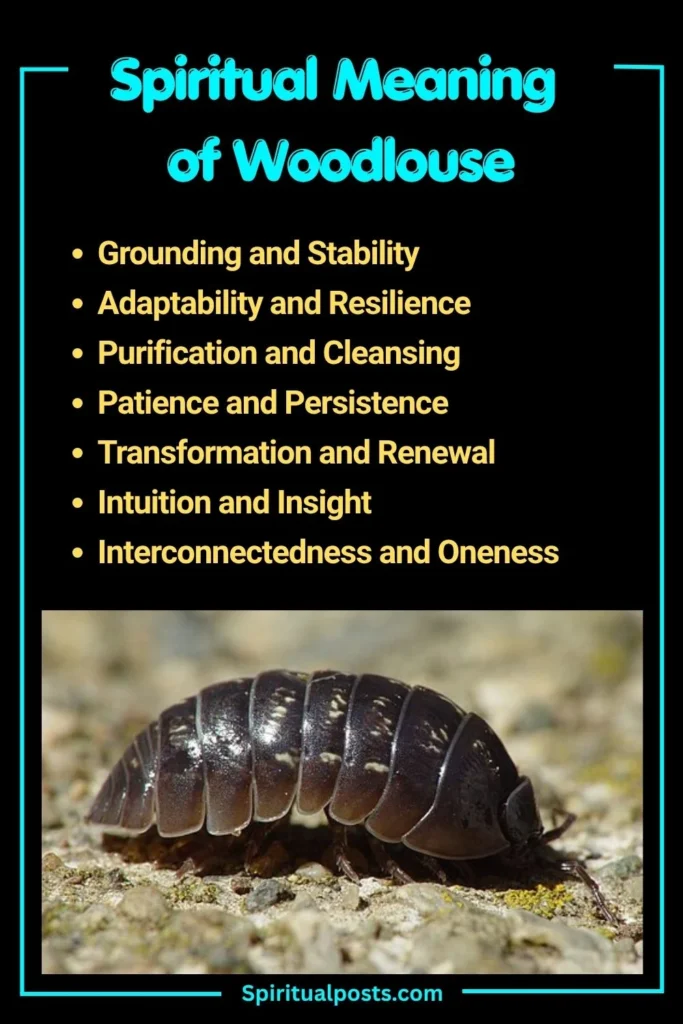
You’ll find the woodlouse carries deep spiritual meanings. It represents grounding and stability, reminding us to stay centered even in times of change.
This adaptable creature also symbolizes resilience, teaching us to weather life’s challenges with patience and persistence.
Ultimately, the woodlouse’s transformative qualities point to the power of renewal and purification.
Grounding and Stability
Woodlice symbolize the grounding and stability needed to navigate life’s ups and downs, reminding you to stay rooted in the present moment. These unassuming creatures are experts at adapting to their environment, thriving in even the most challenging conditions. Much like woodlice, you too can cultivate a sense of groundedness and resilience to weather any storm.
When you feel unbalanced or adrift, look to the woodlouse as a guide. Its ability to cling tightly to surfaces, grounded and secure, can inspire you to find your own inner stability. Just as the woodlouse relies on its hard exoskeleton for protection, you can build up your own emotional and spiritual armor to face life’s uncertainties with confidence.
Embrace the woodlouse’s steadfast nature, and let it teach you the art of weathering life’s changes with grace and adaptability. By embodying the woodlouse’s grounding energy, you’ll discover the strength and composure to navigate even the most turbulent times.
Adaptability and Resilience
In addition to grounding and stability, woodlouse embody the spiritual qualities of adaptability and resilience – characteristics that can inspire you to navigate life’s ever-changing landscape with ease and confidence.
These humble creatures thrive in a wide range of environments, from damp forest floors to arid urban crevices, seamlessly adjusting to the conditions around them. Their ability to roll up into a protective ball when threatened reflects an innate capacity to respond to challenges with flexibility and fortitude.
Just as woodlouse adapt to their surroundings, you can learn to embrace the unpredictable nature of life, rolling with the punches and finding innovative ways to overcome obstacles. Their resilience serves as a reminder that even in the face of adversity, you possess the inner strength to weather any storm.
Draw inspiration from the woodlouse’s unwavering determination, and let their example empower you to approach life’s ups and downs with a adaptable and resilient mindset.
Purification and Cleansing
Alongside their grounding and adaptable qualities, woodlouse carry symbolic meanings of purification and cleansing that can inspire your spiritual journey.
These humble creatures are often associated with the process of decomposition, breaking down organic matter and returning it to the earth. This cycle of transformation represents the idea of spiritual purification – the shedding of old, stagnant energies to make way for renewal and growth.
Woodlouse are particularly adept at consuming decaying plant matter, acting as natural recyclers and cleansers of their environment. This process mirrors the spiritual concept of purification, where you let go of limiting beliefs, emotions, and behaviors to create space for positive change.
Patience and Persistence
As you observe the woodlouse’s steady, unrelenting efforts to break down organic matter, you’re reminded of the power of patience and persistence on your own spiritual path. These unassuming creatures may seem insignificant, but their unwavering dedication to their role in the ecosystem offers valuable lessons.
The woodlouse’s ability to patiently and persistently decompose decaying organic matter is a testament to its resilience and determination. Similarly, your spiritual journey may at times feel slow and arduous, but like the woodlouse, you must embrace the virtues of patience and persistence to overcome obstacles and make progress.
Just as the woodlouse methodically breaks down dead leaves and twigs, you must approach your spiritual growth with a steady, unwavering focus. Resist the temptation to become discouraged by setbacks or to rush the process. Instead, draw inspiration from the woodlouse’s example and continue to work diligently, trusting that your efforts will bear fruit in due time.
Transformation and Renewal
The woodlouse’s remarkable ability to transform and renew the environment serves as a powerful metaphor for your own spiritual journey. Just as these unassuming creatures break down decaying organic matter, you too can shed worn-out beliefs and patterns, making way for growth and rebirth.
Woodlice are nature’s recyclers, processing dead leaves, wood, and other organic detritus, returning its nutrients to the soil. In the same way, your personal transformation involves letting go of outdated ways of thinking and being, allowing you to emerge as a more vibrant, authentic version of yourself.
As you embark on this process of renewal, take inspiration from the woodlouse’s adaptability and resilience. These small creatures thrive in diverse habitats, from damp forests to urban gardens, demonstrating their ability to adapt to changing circumstances. Similarly, your spiritual evolution will require the flexibility to navigate life’s twists and turns, embracing the ebb and flow of transformation.
Trust the woodlouse’s example, and allow your own metamorphosis to unfold with patience and grace.
Intuition and Insight
Woodlice possess a keen intuition that can sharpen your own perceptive abilities, guiding you towards deeper insights. Their nimble movements and acute senses allow them to navigate even the darkest, most obscured environments, a skill you can emulate in your spiritual journey.
These unassuming creatures are adept at perceiving subtle energies and shifts, tapping into the rhythms of the natural world. By observing their behavior and embodying their qualities, you can cultivate a heightened awareness and sensitivity that will open you up to new realms of understanding.
Woodlice are masters of adapting to their surroundings, a trait that can inspire you to be more flexible and receptive in your own life. Their willingness to explore the unknown and seek out hidden pockets of wisdom reflects a profound intuitive intelligence that you can harness for your personal growth.
As you attune yourself to the lessons of the woodlouse, you’ll find your inner vision expanding, allowing you to access profound insights and make more informed decisions on your path of spiritual discovery.
Interconnectedness and Oneness
Because woodlice are deeply connected to the natural world, you can use their example to cultivate a greater sense of interconnectedness and oneness in your own life.
As these tiny creatures crawl through the soil, they seamlessly integrate with their environment, reminding us of our own innate connection to the earth and all living things.
Just as woodlice are an integral part of their ecosystem, constantly breaking down organic matter and cycling nutrients, you too are an essential component of the larger web of life.
Woodlouse Symbolism in Different Cultures and Contexts
Woodlouse symbolism has been a part of various cultures around the world. From the native tribes of North America to the ancient Celts and Nordics, these humble creatures have held spiritual significance.
Similarly, African and Eastern philosophies have incorporated woodlouse into their belief systems, recognizing the creature’s role in the cycle of life.
As you delve into the spiritual meanings associated with woodlouse, you’ll uncover a rich tapestry of cultural traditions and perspectives.
Native American Culture
Across Native American cultures, the humble woodlouse has long been imbued with profound symbolic significance, its diminutive form belying the depth of its spiritual resonance. Known by many names, from the Anishinaabe’s ‘Zhiishiib’ to the Navajo’s ‘TséébiiĒkai,’ these unassuming creatures have been revered as embodiments of resilience, adaptability, and the cyclical nature of life.
In the traditions of the Pueblo peoples, the woodlouse is seen as a keeper of ancestral wisdom, its ability to thrive in the darkest, dampest corners of the earth a testament to the enduring power of the natural world. The Hopi, in particular, have long incorporated the woodlouse’s image into their intricate sand paintings, using its segmented form to represent the interconnectedness of all living things.
For the Lakota, the woodlouse’s role as a scavenger and decomposer has imbued it with a sacred duty to facilitate the transformation of the old into the new, a vital part of the great circle of life.
Celtic Culture
Alongside the profound symbolism found in Native American cultures, the woodlouse has also held deep significance within the rich tapestry of Celtic traditions.
In ancient Celtic lore, the humble woodlouse, or ‘roly-poly,’ was revered as a symbol of resilience, protection, and the cyclical nature of life.
The Celts believed that the woodlouse’s ability to curl up into a ball when threatened represented its power to withstand adversity and emerge unharmed. This resilience was seen as a metaphor for the human experience, inspiring Celtic people to face life’s challenges with courage and adaptability.
Moreover, the woodlouse’s close association with the earth and its tendency to burrow and conceal itself were interpreted as signs of the creature’s connection to the underworld and the realm of the ancestors. This symbolic link to the unseen world and the cycle of birth, death, and rebirth was deeply important in Celtic spirituality.
Nordic Culture
In Nordic countries, you’ll find the woodlouse (or ‘kråkeball’ as it’s often called) deeply embedded in the region’s rich cultural tapestry. Known for its resilience and ability to thrive in even the harshest environments, the woodlouse has long been revered in Nordic mythology and folklore.
Within the Norse pantheon, the woodlouse is sometimes associated with the god Freyr, the deity of fertility, prosperity, and wealth. In this context, the woodlouse is seen as a symbol of abundance and survival, its ability to adapt to challenging conditions mirroring the resilience of the Nordic people.
Additionally, the woodlouse’s propensity to curl up into a tight ball when threatened has led to it being linked to the concept of protection and defensive posturing. In some Nordic traditions, the woodlouse is believed to possess the power to ward off negative energies and offer a safe haven for those in need of spiritual refuge.
African Culture
In parts of Africa, you’ll find the woodlouse revered for its symbolic ties to resilience and longevity. This small, unassuming creature is believed to possess profound spiritual significance in certain African cultures.
For instance, in some regions, the woodlouse is seen as a representation of the cycle of life and death. Its ability to adapt and survive in a variety of environments is thought to mirror the resilience and adaptability of the human spirit. The woodlouse’s tendency to curl up when threatened is also interpreted as a symbol of protection and self-preservation, virtues highly valued in many African traditions.
Moreover, the woodlouse’s long lifespan, relative to its size, is believed to imbue it with a sense of wisdom and knowledge. In some African belief systems, the woodlouse is seen as a conduit to the spiritual realm, offering guidance and insight to those who revere it. Its presence is often associated with good fortune, longevity, and the preservation of one’s lineage.
Eastern Culture
The woodlouse’s symbolic significance extends beyond African cultures, with Eastern traditions also revering this unassuming creature for its metaphorical ties to longevity and resilience.
In Chinese philosophy, the woodlouse is seen as a representation of the yin-yang principle, with its ability to curl up into a protective ball mirroring the harmonious balance between opposing forces. This humble arthropod is also associated with the idea of patience and perseverance, as it persistently navigates through the crevices and darkened spaces it inhabits.
In Japan, the woodlouse is known as the ‘roly-poly’ and is viewed as a symbol of good luck and longevity. Its capacity to withstand harsh environmental conditions is seen as a metaphor for the resilience and adaptability required to overcome life’s challenges. Additionally, the woodlouse’s tendency to gather in groups is interpreted as a testament to the importance of community and cooperation, values deeply rooted in Eastern cultural traditions.
Hindu Culture
Beyond Eastern traditions, you’ll find the woodlouse holds symbolic significance within Hindu culture as well. This unassuming creature is revered for its ties to the cyclical nature of life, representing the endless process of birth, death, and rebirth that lies at the heart of Hindu spiritual beliefs.
In Hindu mythology, the woodlouse is often associated with the deity Vishnu, the preserver and protector of the universe. Its ability to curl up into a ball is seen as a metaphor for the soul’s journey through the cycles of existence, with the woodlouse’s compact form mirroring the idea of the atman, or individual soul, merging with the brahman, or universal divine essence.
Furthermore, the woodlouse’s resilience and adaptability are celebrated in Hindu thought, as they embody the qualities of persistence and the ability to thrive in even the most challenging environments. This resonates with the Hindu emphasis on personal growth, discipline, and the transformation of the self through spiritual practice.
Arts and Literature
While Hindu culture reveres the woodlouse’s symbolic ties to cycles of life, you’ll also find this unassuming creature inspiring artistic and literary works across diverse cultures.
In ancient Greece, the woodlouse, or ‘oniscus,’ was a recurring motif in poetry and visual arts, often representing resilience and adaptability.
Medieval European bestiaries, compendiums of mythical creatures, frequently depicted the woodlouse as a symbol of patience and perseverance.
More recently, modern artists have incorporated the woodlouse into their work, exploring themes of nature, vulnerability, and the interconnectedness of all living things.
Japanese haiku poets, for instance, have long celebrated the humble woodlouse, likening its quiet dignity to the transience of life.
Similarly, contemporary writers in the West have used the woodlouse as a metaphor for the human experience, highlighting our capacity to thrive in unexpected places and endure even the most challenging circumstances.
Mythology
Across cultural divides, you’ll find the humble woodlouse embodying a rich tapestry of mythological symbolism. From ancient Mesopotamia to contemporary Japan, this unassuming creature has captivated the human imagination, representing resilience, perseverance, and the cyclical nature of life.
In Sumerian and Babylonian belief systems, the woodlouse was associated with the goddess Inanna, a complex figure representing both fertility and the underworld. The creature’s ability to curl into a ball was seen as a metaphor for the cyclical journey of the soul, reflecting the goddess’s own descent into and return from the realm of the dead.
Similarly, in Japan, the woodlouse, or ‘konchu,’ is linked to the concept of ‘mujō,’ the impermanence and transience of all things. Its adaptability and tenacity are celebrated as reminders of the constant flux and regeneration inherent in the natural world. This symbolism is often incorporated into traditional Japanese art and literature, serving as a poignant meditation on the human experience.
Woodlouse Biblical Meanings (with relevant bible verses)
The woodlouse, also known as the rollie pollie or pill bug, holds intriguing biblical symbolism. In the Book of Leviticus, the woodlouse is listed among the ‘creeping things that creep on the earth’ deemed unclean for consumption (Leviticus 11:41-42). This designation reflects the woodlouse’s association with the earthly realm and its lowly, crawling nature, which was viewed as impure by ancient Israelites.
The woodlouse’s ability to curl up into a protective ball when threatened has also been interpreted as a symbol of resilience and the ability to withstand life’s challenges. In this sense, the woodlouse can be seen as a metaphor for the faithful who endure adversity with steadfastness and faith in God.
Additionally, the woodlouse’s scavenging habits have been linked to the biblical concept of gleaning, where the poor were permitted to gather leftover crops from the fields (Leviticus 19:9-10). This connection suggests the woodlouse’s role as a provider and sustainer of life.
Spiritual Meaning of Dream About Woodlouse
If you’ve had a dream about a woodlouse, it may symbolize your ability to adapt and protect yourself during challenging times. The woodlouse’s curled-up defense mechanism reflects your own resilience in the face of adversity.
This dream could represent your tendency to retreat or withdraw when faced with difficult situations, similar to how the woodlouse rolls up to shield itself. It may suggest a need for you to be more proactive in addressing your problems, rather than retreating into your shell.
Alternatively, the dream may indicate that you’re going through a period of change or transformation, and the woodlouse is a symbol of your adaptability and ability to navigate these transitions.
Pay attention to the context and your own feelings in the dream, as they can provide additional insights into the spiritual meaning behind this encounter with a woodlouse. By understanding the symbolism, you can gain valuable self-awareness and guidance for navigating the challenges in your life.
Woodlouse Spirit Animal, Totem, and Power Animal
In addition to its symbolic meaning in dreams, the woodlouse can also serve as a spirit animal, totem, or power animal, offering valuable lessons and insights for your personal growth and development.
As a woodlouse spirit animal, this unassuming creature can remind you to be adaptable, resilient, and to find strength in your ability to navigate life’s challenges. The woodlouse’s connection to the earth and its capacity to thrive in diverse environments can inspire you to remain grounded and connected to the natural world, even amidst the demands of modern life.
As a woodlouse totem, this animal may symbolize your capacity for introspection, your willingness to retreat and recharge when needed, and your appreciation for the cyclical nature of life. The woodlouse’s habit of curling up into a ball when threatened can also suggest the importance of self-protection and the need to create boundaries when necessary.
Embracing the woodlouse as a power animal can empower you to tap into your own resourcefulness, patience, and determination, traits that will serve you well on your spiritual journey.
Conclusion
The woodlouse, with its resilience, adaptability, and connection to the cycle of decomposition, offers profound spiritual insights.
Its symbolism reflects the capacity to navigate life’s challenges, embrace transformation, and honor the interconnectedness of all things.
Whether encountered in the natural world or in dreams, the woodlouse invites us to deepen our spiritual awareness and find strength in the face of life’s ups and downs.


